Friday, 29 May 2015

INTRODUCTION


Project CARS: Formula B at Spa
Ever since racing games became popular, some people wanted more realism than what games like Gran Turismo, and Forza Motorsport were offering. People wanted to really feel like they were driving a racing car, as accurately as possible, people wanted to give their expensive setups something to chew on. Because of this, more realistic racing games were created, these were referred to as racing sims.

A Quick History Lesson: The Advent of the Modern Racing Sim

The earliest racing sims were games like Indycar Racing (1993) and NASCAR Racing (1994) by Papyrus, a development studio formed by David Kaemmer, and the F1GP (1992) (later - "Grand Prix") games created by MicroProse (headed up by Geoff Crammond). These two developers quickly entered competition with each other, releasing many racing sims between them, with David Kaemmer's final game (with Papyrus) being NASCAR Racing 2003, and Geoff Crammond's final game being Grand Prix 4 (2002). One of the most legendary racing sims came out of this era. In 1998, Papyrus released Grand Prix Legends, a racing sim focused on 1960s Formula 1 racing (Specifically, the 1967 season).

In the late 90s, a new developer joined the world of sim racing. Image Space Incorporated (ISI) started developing their own Formula 1 series in 1999, releasing their final F1 game in 2003, which contained all of their previous games (1999, 2000, 2001 and 2002) in one package. They also released rFactor in 2005. This is when modding became an important aspect of sim racing.

In the mid-2000s, a modding group named SimBin licensed the engine that ISI used to create rFactor (ISIMotor2), and released several of their own racing sims based on that engine. For the first time, a proper Grand Touring simulator had been created! GTR (2005) was based on the 2003 FIA GT Series, with the sequel (GTR2) releasing in 2006, based on the 2004 season. They also released GT Legends in 2005, a game based around classic 60s and 70s touring cars, and GT cars. Further down the road, they also created the RACE series, a series dedicated to the World Touring Car Championship.

The modern era of racing sims had begun. Later down the line, more developers emerged. Reiza Studios (another collection of modders using the ISIMotor2 engine) created their Game Stock Car (2011) series, a sim based around the fairly unknown Stock Car Brasil series, and Formula Truck, based around the Brazilian truck racing series.

Another sim appeared in 2009. This time, it was headed up by David Kaemmer! Called iRacing, this racing sim was online only, and featured a complicated and robust license system, which measured the skill and safety of drivers. It was also extremely expensive, a subscription fee and the fact that you have to pay for each car and track (~$7 for a car, and $12-$20 for a track) meant that it didn't have very much support from the masses, but those looking for the most hardcore racing online loved it.

Finally, after many years, ISI released their next game, rFactor 2 (2013). The same year, another racing sim appeared. Assetto Corsa (2013), created by the Italian developer Kunos Simulazoni. Lastly, this year, Slightly Mad Studios released their racing sim, Project CARS.


The World of Sim Racing: Cars, Cars and Automobiles

Assetto Corsa: GT3s at Silverstone
Sim racing is the act of simulating a racing car realistically, more so than most racing games can do. Games such as Forza Motorsport, Gran Turismo, and Codemasters' Race Driver, Grid and Formula 1 series (2010 onwards) appeal to the masses. This means, they cannot afford to be entirely realistic, the majority of people who play them, want to sit on their couch with a controller in one hand, and a Coke in the other. (These games are usually referred to as "simcade" by the community, half sim, half arcade)

On the other hand, the average sim racer wants more, they want to spend hundreds of dollars on sim racing equipment - steering wheels, pedals and shifters. They want to have as much realism as possible, they want much more of a challenge. That is why developers build racing sims.

Sim racing is popular across the world (although the largest concentration of fans exists in the US). Online racing and modding are two large parts of the draw of sim racing. Modding gives the player a huge amount of freedom for what they want to race, throughout all of these more modern sims, you can simulate anything from a 60s F1 car, to a modern Le Mans Prototype, to a World Touring Car Championship racer.

Online racing beats racing against the AI. The races will always be more dynamic, more entertaining, and more challenging. That is, if you can keep up. iRacing is the most famous online racing game of all time, and the most popular.

There are three major disciplines within sim racing, road circuit racing, oval circuit racing and rally racing. For the purposes of simplicity, I will be focusing on road circuits, outside of the section on iRacing. I will also be limiting the articles to a few major sims, since as you no doubt saw in the brief history, there are a lot of them. The sims I have chosen are (in order of release); Grand Prix Legends, rFactor, GT Legends, GTR2, Race 07, iRacing, rFactor 2, Assetto Corsa and Project CARS.
Project CARS: The four classic Lotus's

Disclaimer: All screenshots on this post were taken by me.

THE OLD BREED

Grand Prix Legends: 1967 Brabham at Kyalami
F1 Challenge: F1 1999 at Spa
Grand Prix Legends
Grand Prix Legends is considered to be one of, if not the, hardest racing sims ever. It's this that makes it so legendary. GPL was released in 1998 by Papyrus, and simulated the 1967 Formula One season. These 60s F1 cars were very difficult to drive, and that comes across in the simulator. They didn't have wings or spoilers, so the downforce was entirely mechanical, the cars would sometimes have to almost drift around corners. They were fast, agile, and incredibly dangerous.

There is a rumor that when Sir Jackie Stewart tried GPL, he said that it was more difficult than driving the actual cars. The manual itself states that "You will spin and crash because everyone who tries the simulation spins and crashes the first time out. And the second time out. And the third."

Over the years, the GPL community has been going strong, releasing hundreds of addon tracks, and several new series to the game. These include the '65, '66 and '69 F1 seasons, 1967 Formula Two season, 1967 World Sportscar Championship, and the 1971 CanAm season.

F1 Challenge: 1999 - 2002
F1C was released in 2003, and was Image Space Incorporated's final F1 game, it combined their previous four games (1999, 2000, 2001 and 2002) into a single game, and fixed up a few inaccuracies with the cars and tracks. It is still considered to be a fantastic simulator, and one of the best F1 sims out there. It also included dynamic weather, which added another level of challenge to these already fearsome beasts.

Like GPL, F1C has a large modding community, for instance, the Virtua Le Mans team released Prototype C, a mod containing hundreds of late 80s and early 90s Group Cs, ranging from Le Mans to the IMSA GTP series. F1C VB is a mod that has been in development for years, and contains literally every single year of F1, from 1950 through 2015.

rFactor
rFactor: 1970s Le Mans prototypes at Le Mans 1977

In 2005, ISI released their next game, based on a modified version of the engine that powered F1C. This was called rFactor. This game is notable for being possibly the most modded racing sim in existence.

Although the base game content is rather lacking, the mods range from almost any year of F1, through to endurance racing like Le Mans, touring cars from the BTCC and WTCC, and classic touring cars.

While the game didn't have a rain system like F1C, it did have (and was one of the first sims to have) a day-night cycle. This was a huge development, and added a lot of replayablilty to the game, finally people could actually simulate the 24 Hours of Le Mans in real time.

GT Legends
GT Legends was released the same year as rFactor, by a development team made up of former modders, SimBin. They licensed the rFactor engine from ISI, and got licenses for a collection of classic cars, including touring cars and GT cars from the 60s and 70s. These ranged from Ford Capri's, to a Ford GT40 MK.I. It also featured a selection of modern tracks, rather than tracks from that era like GPL did.

GT Legends: 60s and 70s GT cars at Spa
As with rFactor, there were plenty of mods, although many more tracks than cars. It was annoying to put new cars into the game, as the user himself would have to manually edit a couple of files, so the modding never took off in the way that rFactor's did. Like rFactor, it also included a day-night cycle. It also included a simple career mode, the player goes through a series of championships and earns money to buy cars, the final races were several multi-hour endurance events.

GTR 2

GTR 2 was released in 2006, as SimBin's next game. It was the sequel to GTR 1, a game which is not mentioned in this blog because all of it's content was released in GTR 2 anyway, making the game obsolete. The game contained the 2003 and 2004 FIA GT Championships, including the 24 Hours of Spa for both of those years. As with GT Legends, it was created on ISI's rFactor engine.

GTR 2: GTs at Dubai
The game is notable for including not only a day-night cycle, but also weather simulation. It was by far the best way to simulate a long endurance race, and still is today. Along with the weather and day-night cycle, it also included the ability to save mid-race, and even swap drivers, letting the AI take over for a stint (until they came in to pit next).

Like GTL and rFactor, it contained mods, although it never got up to the point of rFactor's popularity. There were still several good mods, however, the Super GT mod contained the 2005 through 2012 Japanese Super GT500 cars, and the ALMS 2007 - 2010 mod included the American Le Mans Series, adding more endurance racing. Finally, there is the Grid Mod, this mod is more like a community, and is a massive group-effort to create all of the cars of various endurance championships and races, including the 24 Hours of Le Mans, Le Mans Series, ALMS, World Endurance Championship, and a couple more.

Race 07
In 2007, SimBin released their next game, Race 07. This game used the same engine, and had a license for the 2006 and 2007 World Touring Car Championship, along with a selection of additional content, including a couple of late 80s touring cars, Minis, and a few open-wheelers.

Race 07: Touring cars at Zolder
It contained a weather system, but did not contain a day-night cycle, which is considered to be one of the bad points of the game. It also was one of the first sims to have DLC, expansions which added additional content to the game, including a GT expansion, retro cars, and a few more years of WTCC. Along with this, it contained mod support, although modding never really took off as much as GTR 2 or rFactor.

Disclaimer: All screenshots in this post were taken by me.

THE NEW BOYS

Assetto Corsa
Assetto Corsa: GTE's at the Nordshleife
In 2013, Italian developer Kunos Simulazoni released Assetto Corsa onto the Early Access program on Steam. The game received a large amount of patches, and was finally released into 1.0 in November 2014.
Assetto Corsa is known for it's mod support. There is a large amount of content developed for it, with more being added every day. AC shipped with a large selection of cars, ranging from GTs to road cars like BMW M3s and Lotus's, to super cars like the McLaren 12C and Ferrari 458 Italia. It also shipped with a small collection of hyper cars, including the LaFerrari, Pagani Zonda R and Pagani Huayra.

It is also noted for being one of the only sims that uses laser-scanned tracks, a process that makes the tracks much more accurate, by scanning the surface with a laser, allowing incredible detail on the camber, height difference and exact accuracy on the width and length of the track, and on the angles of the corners. Tracks on release included Spa, Monza, Silverstone, Imola and the Nurburgring GP course.

In 2015 the first DLC was released, this included the other part of the Nuburgring (The legendary Nordshleife) and 10 cars, including the McLaren P1, Sauber C9, and Alfa Romeo GTA. It is currently priced at $17NZ.

While the game itself is missing some features that should be standard in a modern racing sim (such as weather simulation, and a day-night cycle), it does have incredibly accurate physics.

rFactor 2
rFactor 2: Corvette GT2s at Silverstone
Image Space Incorporated released rFactor 2 (obviously the sequel to the original rFactor) in 2013. Since then, the game has been constantly updated with additional content, including Indycars, Formula 2, GT cars, the occasional road car, and a collection of classic open-wheelers. rF2 is considered to be one of the most feature-rich racing sims on the market, with a full weather simulation system, a day-night cycle, and RealRoad, their custom built dynamic surface system. 

RealRoad simulates cars putting rubber onto the track, in a dynamic way rather than a scripted way like other sims. This means that the track surface would be more rubbered-in closer to the end of a long race, due to the cars rubbing their tires over the surface. This gives the cars more grip. This is most prevalent in corners where cars are breaking and accelerating. This system also carries over between sessions, so at the beginning of a practice session the track would be un-rubbered and less grippy, but over the course of the session rubber would be added to the track. This would carry over into the qualifying sessions, and finally, by the time you got to the race, you would have a fully rubbered-in track.

Unfortunately, rFactor 2's community never really took off the way that AC's did. While AC has a large amount of mods available, rF2 has significantly less, especially in terms of cars. However, the mods that are there are generally higher quality than the ones in other sims, especially the two United Racing Designs payware addons, which include GTE and DTM based cars.

Project CARS
Project CARS: Classic Group A at Bathurst
Project CARS (Community Assisted Racing Simulator) was released in early May this year, after spending 3 years in Slightly Mad Studio's closed beta system. It includes possibly the largest diversity in it's content, ranging from classic touring cars through to modern GT, prototypes and open-wheelers. It's notable for including both weather simulation and a day-night cycle, and also includes the Circuit de La Sarthe, the course on which the 24 Hours of Le Mans is run, the race itself is included as an event in the career mode.

It offers a detailed career mode, better than any other sim available (indeed, almost no other sims actually have a career mode, but rather a series of championships you can do at any time, in any order). The career mode allows you to start in whatever "tier" you wish, the lowest being go karts, the highest being Formula A (SMS's own version of F1) and the LMP1 class, along with a huge amount of content in between. You play through a season, at the end of that season, you can pick a new contract based on your performance. It's a simple system, but it adds a lot of replayablility to the game and forces you to drive cars and tracks that you normally wouldn't.

Unfortunately, the game does not have mod support, which will cause the community to suffer later on. The physics are also considered to be sub-par by some, in general, the sim doesn't really do anything incredibly, but does everything decently, meaning it's one of the best choices for somebody's first sim, or if you're just looking for a bunch of content to play around with.

Project CARS is interesting in the way that it was developed. As part of the aforementioned closed beta (which you could only buy into for a certain amount of time, I missed out unfortunately) the game's direction was decided on by the community, they voted on what content they wanted to be added to the game, and what the focus of the title should be. This sparked a lot of controversy, as some people didn't like the outcome, claiming that they were "ripped off" because the game was different from what they wanted.

Disclaimer: All screenshots on this post were taken by me.

ONLINE RACING

iRacing
iRacing: McLaren 12C GT3

Online racing is a large part of sim racing. The most popular simulator for online racing is by far iRacing. This sim had been built from the ground up to be an online only racing simulator, and has a lot of features designed to keep the racing fair and competitive. Firstly, it has a subscription fee, unlike other simulators. On top of this fee, you are required to purchase the content you wish to use (apart from a small amount you get for free with the subscription, just to get you started), cars cost $8, while tracks cost $12 (with the exception being the Nordshleife, which is $20). The tracks are also laser-scanned, like Assetto Corsa. This means that the game can be quite expensive, in order to run a full "series" (iRacing's version of a championship) you'd have to purchase a car in that class, along with any tracks. You do, however, get some money back if you participate in more than 80% of the races in that series.

The game also features a license system. It is split into two categories, road and oval. Each upgrade separately. The first stage is the Rookie license, this is made up of a couple of road and oval championships using the base ("free") content. Each series has a race running each hour, and you are able to participate as many times as you want, this ensures there is always something to do. As you race, you earn iRating and safety rating. iRating is based on your overall skill, I.E, where you place in the qualifying and races. Safety rating is based on how safe you are as a driver. You start the race with 18 points, each contact with another car, runoff, or contact with a wall depletes points depending on the severity of the impact, this will either increase or decrease your safety rating at the end of the race. In order to be promoted you must participate in a certain number of races, and attain a minimum safety rating.

All series have a schedule, at the end of this schedule, the season ends. There are four seasons in a year, and you'll be promoted automatically at the end of a season, if you have the requirements. Outside of the Rookie license, you gain access to more and more series, and more and more cars, ranging from GT cars to open-wheelers, to NASCARs. This keeps the races fair, and ensures that you do not run across people who simply want to cause trouble and annoy others, usually by crashing into them.

Public Racing and Leagues
iRacing: NASCAR
Outside of iRacing, there are two other ways of playing online, racing on public servers, or running with a league. Most sims have multiplayer, so it's usually not hard to get a race going. If you're running on a public server, however, there is no guarantee of a good race. A lot of servers can be infested by people who simply want to annoy people, usually by ramming them across the road, or by cutting the course. The only way around this, is to join a league. A league is a group of people who race to a specific schedule, these are usually moderated, and people who do not follow the rules get banned.

All screenshots on this page are taken from the Steam page for iRacing: http://store.steampowered.com/app/266410/

HARDWARE


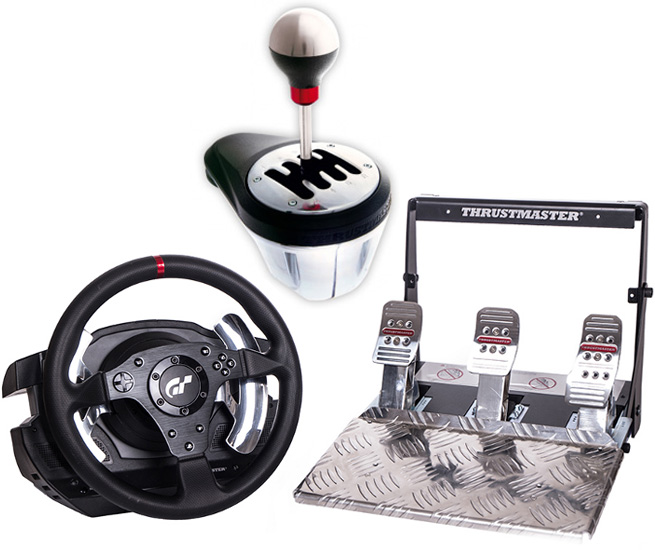
http://www.openwheeler.co.uk/images/t500rs-wheel-and-th8rs-gear-shifter.jpg
A Thrustmaster T500RS
Hardware is an important part of sim racing. Racers can spend hundreds of dollars on equipment, ranging from steering wheels, pedals and shifters, all the way up to racing seats and full cockpits. Combine this with a triple monitor setup, and you have the basis of extreme immersion in a racing sim.

There are three main companies who make the majority of the wheels, pedals and shifters that sim racers use. Logitech, Fanatec, and Thrustmaster. Logitech is known for making the most basic wheel that a sim racer would use, the Logitech Driving Force GT. They also make two mid-range wheels, the G25 (which I have) and the G27. The DFGT comes with a set of pedals, while the other two come with both pedals, and a 6-speed (plus reverse) H-shifter, too. These are a little outdated, and are usually hard to find first-hand.

Fanatec makes both mid-range and top of the line equipment, the Porsche 911 GT2, GT3 RS and Forza Motorsport CSR wheels are their mid range equipment, and do not include pedals or shifters. These wheels cost between $170 to $250. They also have their Clubsport wheel. This wheel is actually a modular system, comprised of the wheel base (which costs $550 by itself) and a collection of wheel rims, including Formula 1 style wheels, GT, and oval style wheels. These are generally around $100 each. Attaching to these wheels are the Clubsport pedals and shifters ($200 and $150 respectively). On top of all this, they also sell a few other accessories, like a handbrake and a special sequential shifter (for simulating cars like GTE's and modern rally cars).
http://f-wheel.com/sites/default/files/rennsportcockpit.jpg
A Rennsport cockpit, with a full triple-monitor setup (not included)
As well as these, Fanatec sells both seats and cockpits. The CSL seat costs $300, and provides a racing seat and sturdy base to attach your wheels to. Finally, the Rennsport Cockpit costs a whopping $1000, and includes a full cockpit base that all of the wheels, shifters and pedals attach to. It also provides a surface to play 3 monitors on.

Finally, Thrustmaster provides mid- and high-range steering wheels, pedals and shifters. The T300RS costs around $450, but doesn't include an H-shifter or a clutch pedal while the T500RS costs around $580, and also doesn't include a shifter, which must be purchased separately for roughly $140.

Image Source for Rennsport Cockpit: http://f-wheel.com/sites/default/files/rennsportcockpit.jpg
Image Source for Thrustmaster T500RS:  http://www.openwheeler.co.uk/images/t500rs-wheel-and-th8rs-gear-shifter.jpg